

AI in Coworking: How Operators Are Using Automation to Power Operations, Member Experience and Revenue
Scroll through LinkedIn on any given day and you might think AI’s main job is writing slightly-better-than-average emails and filling your feed with generic how-to posts. But inside coworking spaces, something much more practical is happening.
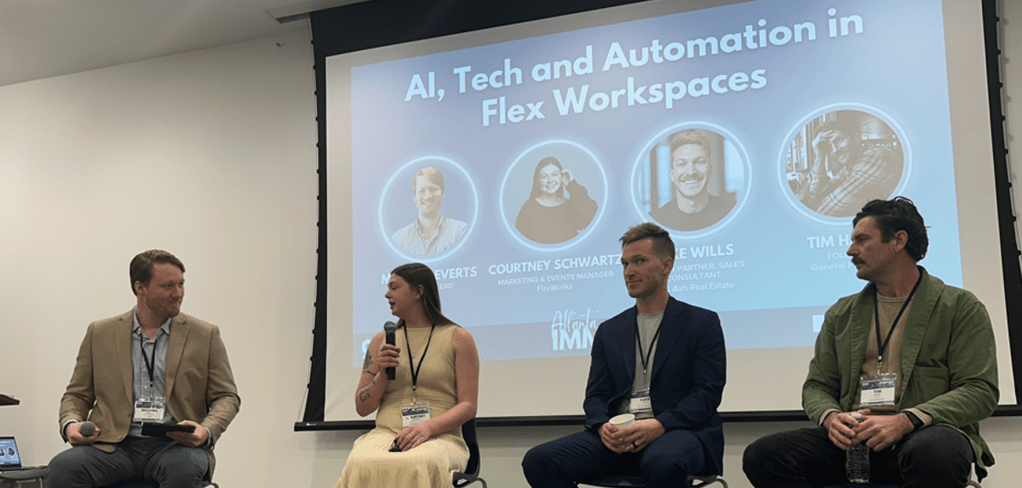
At a recent GWA Immersive conference in Atlanta, Michael Everts—former coworking operator turned Sr Team Lead at Yardi—hosted a conversation with three people who aren’t selling AI tools. They’re actually using them to run, grow and improve their spaces:
- Courtney Schwartz, Marketing & Events Manager at FireWorks Coworking in Marietta, Georgia
- Luke Wills, Sales Consultant & Broker Partner with a background in building outbound sales engines
- Tim Hasse, Founder and CEO of General Provision, a hospitality-driven members’ club and coworking brand based in South Florida
Their experiences all seemed to orbit the same three pillars – Operations, Member Experience, and Revenue. Taken together, their stories paint a realistic picture of what AI looks like in coworking right now: messy in places, powerful in others, and very human at its best.
Pillar 1: Operations – Making the Back End Smarter So People Can Stay Front of House
When most people think about AI, they picture content generation. Courtney thinks about something much less glamorous: Google Business Profile metrics. As Marketing & Events Manager at FireWorks, part of her job is to understand how people are finding the space online. That means digging into clicks, views, interactions, discovery searches, local SEO performance and all the other terms Google throws at you. The challenge is less “getting data” and more “turning that data into decisions.”
Instead of trying to interpret everything manually each month, she’s trained ChatGPT Plus to act like a kind of marketing analyst that knows FireWorks inside and out. She’s told it who they are as a brand, who they serve and where they’re located. When the new data comes in, she drops it into that AI “brain” and asks a simple question: What should we do next?
The output isn’t magic, but it is specific. It suggests tweaks to the website, content ideas for social, and small optimizations to help with local search. What used to feel like a vague sense of “we should do more with SEO” has become a monthly feedback loop. The big win is not that she no longer looks at metrics. It’s that she spends far less energy decoding them and far more time acting on them, and importantly, she spends more time in the space with members.

Tim’s operational story looks different on the surface, but it’s driven by the same idea: use automation and AI to take mental load off the team. General Provision runs on a workspace management platform, but Tim and his team also built their own middleware layer, internally named Berkeley. Think of it as glue between their core software, their data, and the tools their team uses every day, like Slack. The goal is simple: their staff should spend as little time as possible logging into software and as much time as possible delivering hospitality.
That’s led to very practical automations. Anniversary dates, upcoming renewals, cancellations and other key events don’t sit hidden in a database anymore. They surface as Slack messages that say, in effect, “Here’s what’s about to happen—go do something about it.” So instead of relying on someone to remember that a member’s contract is up in two weeks, or that a new member is walking through the doors for the first time today, the system taps the team on the shoulder at the right moment. They still make the decisions and have the conversations. AI and automation simply make sure those moments aren’t missed.
Tim made an important distinction during the panel. A lot of what we call “AI” in conversation is really just automation—logic like if this happens, then do that. For years, tools like Zapier have allowed operators to connect systems and trigger workflows without writing code. He sees those building blocks as the foundation. AI then sits on top, interpreting text, generating responses or adding intelligence to those existing flows.
Pillar 2: Member Experience – Keep the Human Human, Automate Everything That Gets in the Way
If operations is where AI hides, member experience is where the boundaries matter. General Provision describes itself as a hospitality-driven members’ club. Coffee is not an amenity; it’s a craft. Food and beverage aren’t side projects; they’re part of the identity. For Tim, that means something very specific: you don’t automate the parts of the business that are the experience.
Tours, first-day welcomes, and hand-delivered lattes remain deeply human. What they have done, though, is build automations around those moments so that they happen consistently. A good example is the first 30 days of membership. Tim sees that first month as crucial for retention. New members are forming their opinion of the space, meeting people (or not), and deciding whether this is somewhere they want to commit to. Behind the scenes, their systems track when a new member accesses the space through their door system. On the first visit, a message hits the right Slack channel telling the team to give them an especially warm welcome. On subsequent visits, the prompts shift: introduce them to another member, check in on how their first week is going, invite them to an upcoming event. The staff still decides how to act on that nudge, and they still show up as themselves. AI and automation simply make sure those touchpoints actually happen.
Luke and Courtney both echoed the same theme from different angles. For them, the line between helpful AI and “AI slop” is easiest to see in content and communication. Courtney pointed out that if your online presence doesn’t match the reality of your space, you set people up for disappointment before they even arrive. With tools like ChatGPT, it’s easy to generate polished, generic content that sounds good but doesn’t sound like you. Someone finds you through search, scrolls through your website and social accounts, and arrives with a mental picture. If the tone, energy and style they encounter in person don’t match what they saw online, something feels off. That’s one reason she still writes and speaks in her own voice and uses AI as a helper, not a replacement. She might ask it to help refine a post, repurpose content for a different channel or brainstorm ideas, but she’s careful not to let it erase the personality of FireWorks.
Luke has seen the same thing play out on LinkedIn. Content that leans too heavily on generic AI phrasing simply doesn’t perform as well. People can feel when a post isn’t written by a real person with a real opinion. The algorithm can too. As he put it, if everything you publish looks and feels like everything else in the feed, why would anyone stop scrolling? Interestingly, he’s found that using the voice feature in ChatGPT produces better starting points than typing. When you talk through an idea out loud, you naturally add more context, nuance and personality. That gives the model more to work with and gives you something that sounds closer to how you actually speak.
Across all of this, a simple exercise emerges for operators: decide what you will never automate. Your list might include tours, conflict resolution, member introductions or sensitive billing conversations. Once those guardrails are clear, the goal becomes freeing up your team from everything else so they can be fully present in those moments.
Pillar 3: Revenue – Turning AI into a Tireless Sales Assistant
If operations keeps the machine running and member experience gives it a soul, revenue is what allows you to keep the doors open and grow. The panelists all agreed that AI is already reshaping sales in meaningful ways.
This is where Luke spends most of his time. His background is in building outbound sales engines for flex space providers, and he sees AI as a way to scale what used to require big teams. The process usually starts with better data. Tools like Apollo let him find decision-makers—names, emails and often direct cell numbers—for companies that fit his ideal customer profile. LinkedIn Sales Navigator helps him build targeted lists by title, industry, location and company size. From there, AI-driven tools handle much of the initial outreach: email sequences, SMS campaigns, follow-ups to old leads who may be back in the market. One of the most effective plays he mentioned was re-engaging “closed-lost” leads six to twelve months after they chose another space. People change offices. Companies outgrow their footprint. Deals that were lost a year ago can quietly become opportunities again.
But this is also where some of the best war stories come from. Luke told one about using AI texting at scale. A prospect asked for information on all of their locations. The AI agent, doing exactly what it was trained to do, responded with a separate text for every single one, producing 26 messages in a row, each with its own link and address. When the prospect finally replied “stop,” the system, designed to be persistent, kept pushing.
It was a good reminder that AI doesn’t eliminate error; it just changes the kind of error you get. Instead of a rep forgetting to reply, you get a system that replies a little too enthusiastically. Tim’s sales engine looks a bit different but shares the same logic. His team scrapes data from Apollo, runs it through Zapier to clean and filter it, and then pushes cold leads into dedicated email domains reserved for outbound. That protects their main brand domain from deliverability issues. Once someone engages, they move into the primary CRM, where a virtual sales agent—powered by AI and their own knowledge base—handles much of the structured follow-up. The goal is not to remove humans from the process. It’s to make sure no one inquires, tours or shows interest and then quietly disappears because someone got busy and forgot to respond.
Courtney’s approach at FireWorks is more compact but follows the same principle. With a single location and a small team, she doesn’t need an enterprise-grade sales stack. Instead, she leans on AI to drive the top of the funnel: understanding local search behavior, improving how FireWorks appears in Google and other AI-powered search tools, and making sure their messaging matches the way people actually look for space in Marietta. She also uses AI to identify and fix confusion around their name. Plenty of people still call asking if they sell actual fireworks. By understanding which keywords and phrases are leading to those mismatches, she can adjust copy and campaign targeting to attract more of the right leads and fewer “do you sell sparklers?” calls.
Looking Ahead: What Becomes Normal, and What Still Sets You Apart
The panel ended with a look at the near future. Luke believes that in two or three years, automated lead-to-tour workflows will be table stakes. Prospects will expect instant responses, clean scheduling and timely follow-up as the default. The cost difference between having AI handle that first stage and hiring staff to do it manually will be too big to ignore, especially as models continue to improve.
Courtney thinks the real differentiator will be the opposite: the quality of your human interactions. She cited a striking idea—that the majority of content online has already been touched by AI in some way. As models begin to learn more from AI-generated content than from humans, the value of truly human voices, stories and experiences will go up, not down.
Tim, meanwhile, is watching the physical environment. As homes continue to get better tech, better furniture, better lighting and better everything, coworking spaces won’t just be competing with each other. They’ll be competing with their members’ home offices. That’s one reason he’s all-in on hospitality. If you want someone to get dressed, leave the house, fight traffic and walk into your space, the experience waiting for them has to be meaningfully better than what they already have at home.
Taken together, their views form a simple, grounded takeaway:
- Use AI and automation to keep your operations tight and your funnel organized.
- Protect and invest in the human parts of your business that make your space feel alive.
- Treat AI as a set of tools that can buy your team time and focus—not a replacement for the very things your members value most.
The coworking spaces that thrive in the next few years probably won’t be the ones with the flashiest chatbots. They’ll be the ones that quietly use AI in the background while showing up more fully, more consistently and more authentically in the foreground.

Michael Everts
Michael Everts leads commercial marketing at Yardi, where he drives go-to-market strategy, product launches, and campaigns across Yardi's commercial real estate technology suite