

GCUC Manchester 2026: Why AI Only Works When Your Data Does
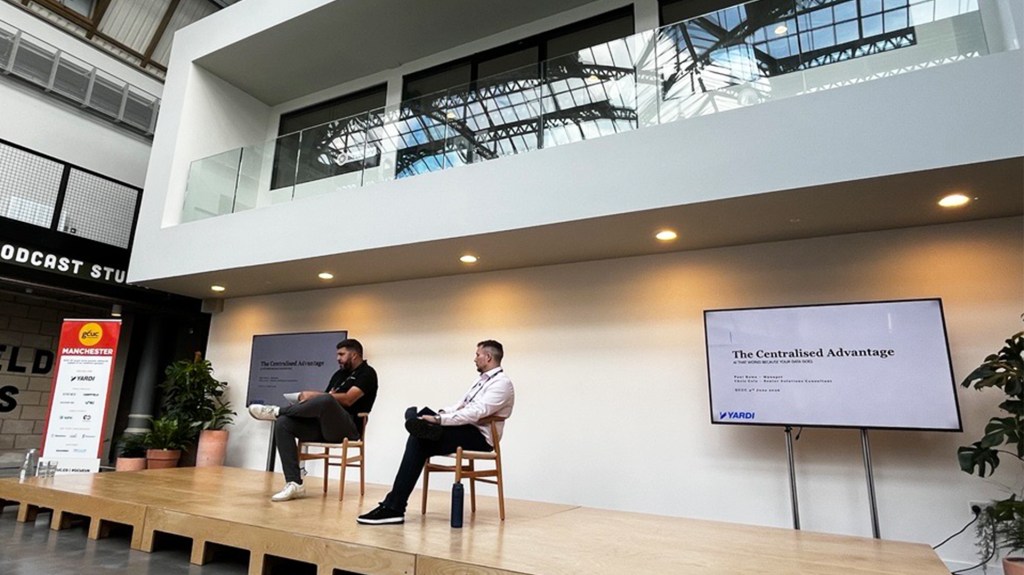
At the recent GCUC Manchester event, Yardi’s very own Christopher Cole, solutions consultant and Paul Rowe, manager, took to the stage to unpack one of the most consequential questions facing flexible workspace operators today – why are so many businesses investing in AI tools and seeing so little return? The session, titled “The Centralised Advantage – AI That Works Because Your Data Does”, made the case that the barrier is rarely the technology itself. It is the fragmented, siloed data infrastructure that sits beneath it.
What followed was a practical, grounded discussion on what ‘AI-ready’ means in day-to-day flex operations – and what the disconnected systems quietly holding teams back will cost them if left unaddressed.
The Real Problem Is Not the AI – It Is the Data
Rowe opened with a challenge that many in the room will have recognised. “One of the biggest issues isn’t actually the AI tools themselves – it’s the data that powers them,” he observed. The pattern he described is familiar – operators start with one system, add another, then another and before long find themselves managing 15 platforms that do not speak to each other. The result is not just inefficiency, it is a ceiling on what AI can ever achieve.
Cole reinforced the point, drawing on a broader perspective on what is at stake for the sector. “Flexible workspace is fundamentally a people business – built on communities, experience, interaction,” he noted. “So, the key question about AI becomes – how do we enhance that human experience and not replace it?” The session framed AI not as a threat to the people-first nature of flex, but as a tool for protecting it – provided the foundations are right.
Where Operators Actually Are & the Gap That Exists
Both Cole and Rowe were candid about the distance between AI ambition and AI reality across the sector. Rowe described a pattern he encounters regularly – operators who feel they may be falling behind their peers and, as a result, overstate how far along their AI journey they are. “There’s often a bit of ChatGPT in an existing system or process – when in fact they could be using their time to reach full potential,” he said. The observation was not a criticism – it was a reassurance that the market has not settled and that the window of opportunity remains wide open. Cole offered a useful reframe for how operators should be approaching AI investment. “When you hire someone, you don’t say ‘how do we use this person?’ – you say, we have a business problem. What is it? And then what can we do to use AI to fix that issue?” he argued. The message was clear – start with the problem, not the tool. Operators who reverse that logic are those most likely to be disappointed by the outcomes.
Three Levels of AI & Why Agentic Is the One to Watch
Rowe outlined a practical framework for thinking about AI capability across three levels. The first – standalone AI, such as ChatGPT, is useful but limited. The second – connected AI, integrates with existing systems via APIs to generate genuinely useful reporting and operational insight. The third – agentic AI is, in Rowe’s view, where the material transformation will come from.
Cole described what agentic AI looks like in practice. “You write a task description and say: when something comes in, I want you to do this, then this,” he explained. “And off the back of that, you create someone almost working in the back office – doing the admin tasks, the chasing, the late invoices, the period close. That frees you up to focus on the human side.” The potential to redirect staff capacity from repetitive administration towards relationship-building and sales is, both speakers argued, where the real value for flex operators lies.
Cole was equally clear about what makes agentic AI work and what makes it fail. “People talk about AI hallucinations – the only way to make sure it works well is with really clean data,” he notes. Without a single, reliable data source, even the most capable AI tool will produce outputs that cannot be trusted.
The Margin Pressure That’s Making This Urgent
The session did not shy away from the commercial stakes. With margins for flex operators typically sitting between 10 and 20%, Rowe argued that operational efficiency is not a nice-to-have – it is existential. “Those modest improvements really matter,” he stated. “The operators who successfully automate parts of their business are more likely to operate at a materially different cost base over the next few years.”
Cole grounded this in a concrete example from Yardi’s own experience. “80% of the queries we used to get that were ticketed and sent to a person – we’ve now got that down to about 20%.” But he was careful to add the nuance that often gets lost in conversations about AI efficiency – “if you don’t hire that person because you think AI can do it, are you just transferring that cost from the human side to more infrastructure and software spend? Being able to speak to a person – and perhaps bump into them in the building – that has real value too.” The session was consistent in its view – AI is most powerful in back-office functions, not as a substitute for human connection.
Where to Start – Practical Advice for Flex Operators
Both Cole and Rowe were direct about where operators most commonly go wrong – starting with the technology rather than the business problem. “Too many AI projects fail when you start with tools rather than business problems,” Rowe warned. His advice was to begin by identifying the specific operational challenge – whether that is reducing vacancy, improving occupancy, automating financial reporting or reducing pressure on staff – and then assess what data is required to address it.
Cole reinforced that the right approach would look different for every operator – “We work with operators running 200 centres and operators running 2… So, based on that, you need to start with – what are we doing here and where do we want to go? Then build the AI on top of that.”
The session closed with a demonstration of Yardi’s own AI integration – using live operator data within Claude to generate dashboards and financial reports in real time, without a single line of code. “The opportunity is huge,” Cole observed. “We think success will come from pragmatic education rather than hype.”
For coworking operators looking to understand what ‘AI-ready’ looks like for their business and how Yardi Kube can support meaningful operational change, speak to a member of our team.
